image of a compass
NDI

The National Democratic Institute is a nonprofit, nonpartisan organization working to support and strengthen democratic institutions worldwide through citizen participation, openness and accountability in government.

Haiti

Haiti-Saint Marc

Since the 1986 fall of the Duvalier family dictatorship, the consolidation of democracy in Haiti has been challenged by the highest poverty rates in the western hemisphere, limited access to education, corruption and a winner-takes-all political culture. The catastrophic 7.0 magnitude earthquake on January 12 claimed more than 230,000 lives, displaced over 1.5 million people and caused widespread physical destruction, placing an overwhelming burden on already weak government institutions. More than a year after the devastating earthquake, progress on national reconstruction remains slow and citizen discontent with the government’s perceived inability to address ongoing needs continues to grow. Against this backdrop, Haitians went to the polls on November 28, 2010 to elect a new president and a third of the legislature. Following controversial preliminary results, a runoff election was scheduled on March 20, 2011 between former first lady Mirlande Manigat and popular pop singer Michel Martelly. Haitian and international experts agreed that, despite some issues, the runoff election represented a significant improvement compared to the chaotic first round. The CEP announced the final presidential election results on April 20, pronouncing Michel Martelly the winner of the election with 68 percent of the votes, while Mirlande Manigat obtained 32 percent.

Current Activities

Post-Election Activities with Political Parties and Elected Officials

NDI is working to support political parties and elected officials to govern more effectively in the post-election period. These activities include:

  • Consultations with parties on post-election strategy and development – providing technical assistance to political parties to help them assess their post-election status and develop strategies for party renewal and restructuring.
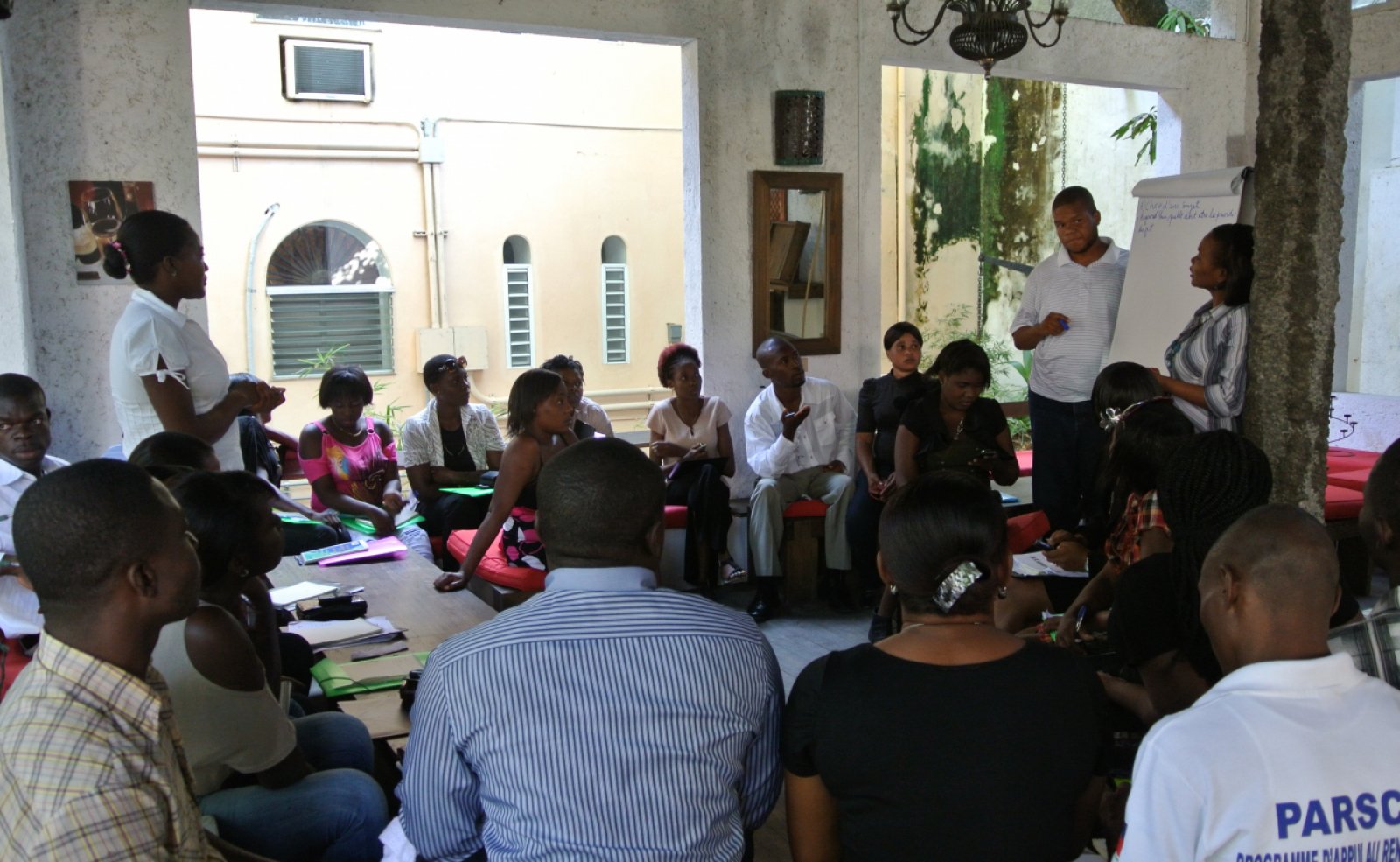
  • Townhall Meetings – a series of town hall meetings at which elected representatives at the national and local levels can engage civil society in dialogue, organized in partnership with community action groups or Initiative Committees (ICs) active across the country. The approximately 180 ICs are a result of a 10-year civic program implemented by NDI and funded by the United States Agency for International Development (USAID).
  • Thematic Policy Forums – a series of thematic policy forums with Members of Parliament to increase their capacity to engage effectively on policy issues, increase cross-party dialogue and promote participation by underrepresented groups such as youth and women.
  • Party caucus orientations – organizing orientation sessions for each caucus represented in parliament to strengthen party caucuses in the new parliament.   

Supporting the Reconstruction Process with the Initiative Committees

NDI is also continuing its support to the reconstruction process by assisting ICs to operate Citizen Information Centers that facilitate dialogues on reconstruction efforts and plans between citizens, local authorities and international and government agencies.

Citizen Information Centers

Since the earthquake, NDI has been assisting ICs to help communities contribute to the reconstruction process. With support from USAID and the Norwegian Ministry of Foreign Affairs, NDI helped ICs open 12 citizen-run information centers (CICs) in Cap Haitian, Les Cayes, Milot, Ouanaminthe, Hinche, Jacmel, Petit Goâve, Saint Marc, Limbé, Gonaïves, Carrefour and Mirebalais, serving both areas directly damaged by the earthquake and locations with large numbers of displaced persons. Over a year after the earthquake, these centers continue to play several roles: gathering and disseminating information on relief resources for displaced persons; facilitating dialogues between citizens and local government officials; liaising with aid workers and international and government agencies at the national and local levels to help provide citizen input and feedback on ongoing relief and future reconstruction plans; and increasing transparency and oversight for the long-term rebuilding efforts at the local level.

Reconstruction Dialogues

With support from the National Endowment for Democracy and in partnership with the ICs, NDI has worked to foster increased citizen understanding and participation in the reconstruction process. At townhall style forums, government officials were invited to present the National Plan for Reconstruction and participate in in-depth discussions and receive feedback from citizens on their local concerns. A range of national and local civic groups, elected officials and government representatives participated in the dialogues including mayors, the business sector, women’s organizations, the Haitian National Police, educators, and religious groups, among others. 

Further, with support from the Norwegian Ministry of Foreign Affairs, the ICs have held a range of communal and departmental dialogues with NDI support across Haiti and produced a series of reports reflecting citizen recommendations and concerns related to the reconstruction process. These reports were synthesized into “Cahiers de Charges,” or Regional Development Roadmaps presented to senate and deputy candidates during the past elections. The issues addressed in these documents range from agricultural policy to needed infrastructure projects. As follow-on to these dialogues, NDI and the ICs will be providing newly elected leaders with the Regional Development Roadmaps and inviting them to participate in a series of departmental workshops and forums to present their reconstruction policies and respond to the community concerns and priorities outlined in these documents.

NDI is also conducting conflict-resolution workshops for IC leaders in partnership with the United States Institute of Peace. The workshops are designed to provide community leaders with the skills to help prevent and mitigate possible conflict related to the impact of displaced persons across Haiti as well as election-related tensions.

Past NDI Programs

Supporting the 2010-2011 Electoral Process

NDI worked to promote peaceful presidential and legislative elections on November 28, 2010 and March 20, 2011 with support from USAID and the Norwegian Ministry of Foreign Affairs.  NDI supported three domestic observation efforts to increase transparency and credibility around the electoral process. NDI also supported approximately 1,200 IC members to conduct a “Get out the Vote” campaign before the first round elections in November, and in March a “Where to Vote” campaign focused on helping voters locate their polling place, based on the challenges experienced in the first round of elections.

In addition to organizing debates for senate and deputy candidates, NDI helped the Haitian Public Affairs Intervention Group (Groupe d’Intervention en Affaires Publiques, GIAP) to organize presidential candidate debates ahead of the first round of elections, and a run-off debate between Michel Martelly and Mirlande Manigat that reached an estimated 71 percent of the Haitian people through radio and television.

NDI also continued its efforts to promote a peaceful electoral process by supporting the activities of over 40 multiparty tolerance committees in violence-prone areas for the run-off election and the drafting of a code of conduct for presidential candidates.

Civic Forum/Civil Society Advocacy

To respond to the need for a more informed and engaged citizenry, NDI initiated the Civic Forum (CF) program in 1998 with community groups in 37 communes in nine of Haiti’s 10 departments. The CF program began with facilitated discussions using NDI’s Citizen’s Guide: From Civic Education to Civic Action, a 12-module civic education resource in Haitian Creole.  After completing the curriculum over the course of the year, the 3,500 participating civic groups encompassing tens of thousands of Haitians were offered the opportunity to apply the principles they had learned by forming community action groups to carry out locally-led citizen initiatives. 

After receiving NDI training in community organizing, teamwork and project management, the majority of groups formed grassroots-based groups called Initiative Committees that identified local priorities and worked to organize their communities to respond to their most pressing needs.  Approximately 179 ICs across the country organized hundreds of projects, including the construction of health clinics, schools and roads, the provision of job-skills training, HIV/AIDS education, reforestation and watershed conservation, potable water, hurricane-relief activities, and the development of self-sustaining kitchen gardens. 

Through a “visioning” process designed to help ICs play a central role in formulating community development plans, ICs also engaged citizens in addressing the immediate needs of the community while linking short-term recovery from natural disasters or political upheaval to long-term community improvement efforts. As the ICs gained greater standing in their communities and began to take on larger projects, they formed Communal Coordination Committees (CCCs) and Departmental Coordination Committees (DCCs) to organize across larger geographic areas.

NDI worked with the CCCs and other civil society partners to implement two advocacy campaigns. The first regional advocacy campaign in the North department sought to increase local input into tourism development plans to create employment opportunities in the Cap Haitian region. With NDI support, the campaign drafted a campaign plan, raised local awareness on tourism development issues, and built a broad-based coalition, including representatives from the private sector and grassroots organizations. NDI also helped an advocacy campaign in northern Limbé to secure support to combat a devastating insect infestation that claimed lives, livestock and crops in the area. Through outreach to Senators representing the area, the campaign helped to ensure that funds in the government’s budget were dedicated to addressing the insect infestation issue.

Democracy for All

In 2002, NDI developed the Democracy for All program (DFA) to enable students, teachers and their families to take action to improve life in their communities.  Patterned after the Civic Forum, after completing the DFA curriculum students became involved in initiatives to strengthen democratic culture and improve life in their communities. Former DFA students have participated in community clean-up efforts, election observation, voter participation drives, committees to promote the inclusion of youth issues on the community agenda, HIV/AIDS awareness campaign organization and civic education plays for the community and radio and television broadcasts.

Political Party Building and Reform

Beginning in 2002, NDI worked to strengthen political processes including training more than 16,000 party activists from approximately 20 political parties across the democratic ideological spectrum in 10 departments. Training themes included democratic institutions and practices, party organizational structures, effective campaigning, ethics, citizen outreach and conflict resolution.  NDI worked to help parties increase representation of traditionally marginalized groups, including women and youth. In addition, NDI assisted parties in developing policy agendas and ideologies, as well as organizing party caucuses in parliament and local branches to help promote responsiveness to party members and citizens.  NDI has facilitated citizen and party dialogue through town hall meetings as well as national radio and television ads promoting dialogue and citizen engagement with political parties.

NDI has also:

  • Organized pollwatching training sessions for party pollwatchers and election dispute resolution trainings for party lawyers during the 2010-2011 elections. These sessions aimed to strengthen political party representatives’ understanding of electoral observation and legal mechanisms to resolve disputes after the elections. NDI trained a total of 1,640 party representatives, who in turn conducted duplicate trainings at their local party headquarters and deployed thousands of party pollwatchers on election day.

  • Facilitated the creation of 13 multiparty tolerance committees to promote political tolerance and dialogue that comprised more than ten political parties in 2008 and 2009./p>

  • Organized eight public debates in 2009 for senatorial candidates to inform voters of their platforms, and to provide an opportunity for candidates to practice recently acquired political communication and debating skills.

  • Helped political parties and their candidates to manage election campaigns, increase their understanding of the election law and formulate political platforms. NDI trained some 847 Senate candidates, party leaders and campaign staff from 11 political parties for the first round of elections in 2009.

  • Sponsored candidate debates for the 2006 municipal and local elections to encourage political parties to present concrete platforms and to provide citizens with an opportunity to hold elected leaders accountable. For the 2006 municipal elections, 40 debates were sponsored with candidates from 26 parties and more than 8,000 citizen participants.

  • Facilitated national and departmental party conventions to encourage grassroots input into policy positions and greater internal democracy in selecting party leaders.

  • Helped to build local party structures and membership bases by training more than 12,000 poll watchers for the 2006 elections, as NDI did for the 1996 and 2000 elections.

  • Facilitated agreement on a national ethics guide in partnership with the Journalists Union, Association of Haitian Journalists and the Federation of Haitian Press to improve the quality of media coverage.

  • Helped set up Electoral Information Centers around the country to provide candidates and the election authorities live access to radio stations to share election information and help Haitians make informed choices about candidates for the 2000 elections.

  • Organized international delegations to observe the 1987 and 1990 national elections.

Contact Information

For more information about these programs, use our contact form or contact:

Washington, D.C.
Diana Paez-Cook, Program Manager
dpaezcook@ndi.org

Port-au-Prince
Ricardo Valverde, Resident Director
rvalverde@ndi.org

  Subscribe to updates about Haiti