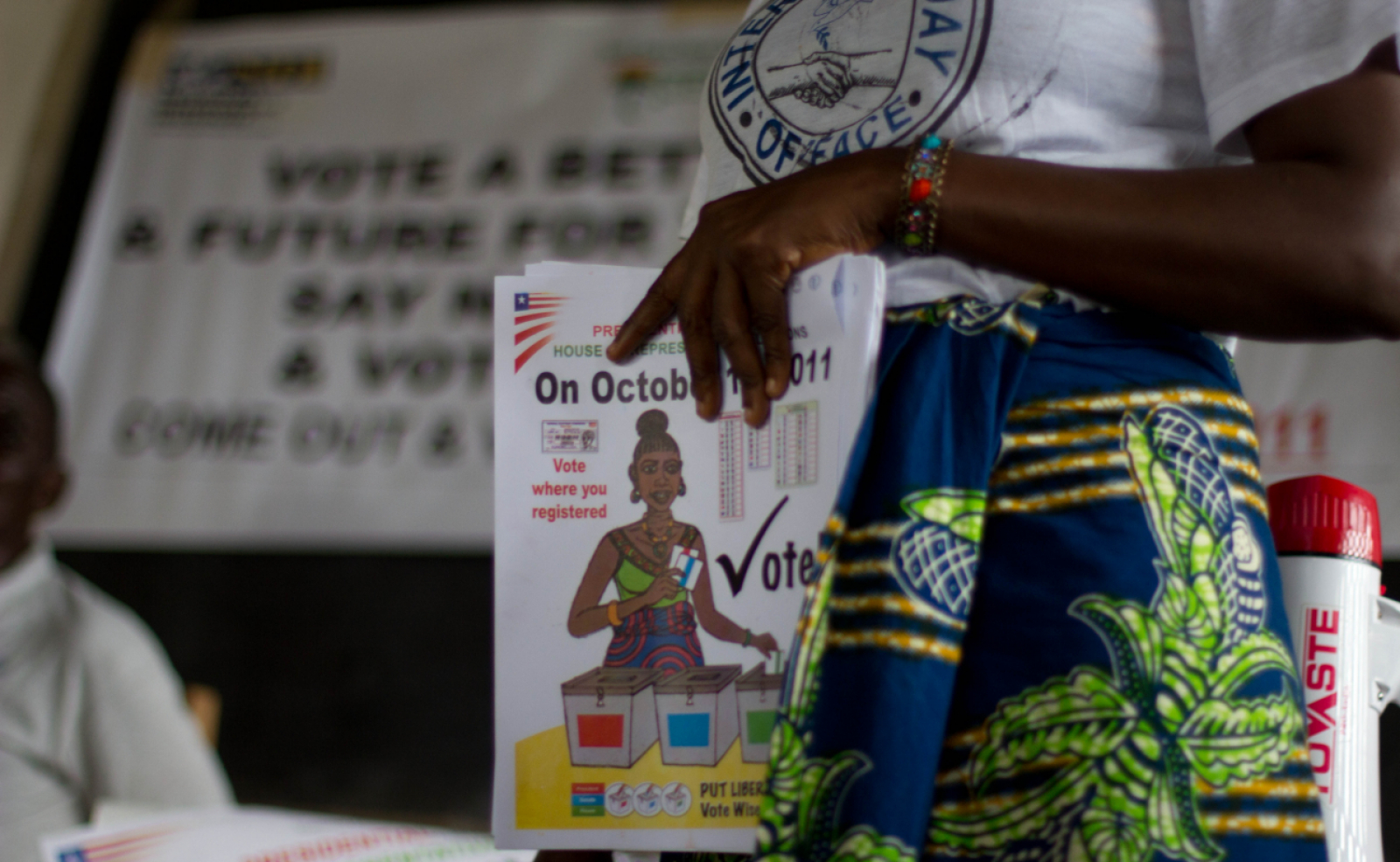
Liberia held general elections on Oct. 11, 2011, and a presidential runoff election on Nov. 8, 2011, the first elections Liberians independently organized since the end of civil war in 2003. These two elections were peaceful, transparent and free of major irregularities, according to both domestic and international observer groups. The decision of the opposition Congress for Democratic Change (CDC) to boycott the runoff vote and subsequent violence that saw at least one CDC supporter killed at a rally undermined the credibility of these historic elections. On Nov. 8, incumbent president and recent Nobel Laureate Ellen Johnson Sirleaf was re-elected for a second six-year term with 90 percent of the vote. Low turnout and the boycott of the runoff election indicate that, while the country continues to progress, on-going efforts toward reconciliation and unification are still needed to preserve Liberia’s peace.
The 53rd Legislature, seated on Jan. 9, 2012, reflects significant turnover in both the Senate and the House of Representatives. Of the 15 seats contested in the Senate, only two members were reelected, and 42 out of 73 House members are freshman. Small parties and independent candidates won 33 percent of the seats in the House, all contributing to a splintered legislature comprised of mostly new members unfamiliar with their legislative roles and responsibilities.
These elections highlight a number of new challenges facing President Sirleaf, the 53rd Legislature and democratic consolidation in a country recovering from civil war. High turnover in the legislature and the frustrations voiced by the opposition CDC give voice to a growing dissatisfaction with the ruling government. As smaller parties win seats in the fractured legislature, the need for coalition-building becomes more apparent. Finally, while security concerns have somewhat abated, other concerns from the last election cycle have not, including unresolved reconciliation efforts, chronic unemployment, delivery of social services and a need for improved infrastructure.
In 2009, the Liberian Legislature adopted a five-year legislative modernization plan (LMP) to improve the ability of lawmakers to fulfill their representative, oversight and legislative functions in support of the country’s recovery and long-term development. The LMP identifies concrete measures to address shortcomings in three key areas: lawmakers’ understanding of and ability to carry out their duties; staff ability to support the legislative process; and infrastructure needs. The legislature has since taken on a host of important issues, including passing legislation that created a transparent regulatory framework for natural resource industries, adopting a Freedom of Information Act and establishing a legislative budget office that will support the legislature with the annual budget process.
Current Activities
NDI is implementing a U.S. Agency for International Development (USAID)-funded program to support the modernization and development of the Liberian Legislature and enhance the credibility of the 2011 election process.
Strengthening Electoral Processes
NDI provided technical and financial assistance to the Elections Coordinating Committee (ECC), a coalition of civic groups dedicated to enhancing the credibility of the 2011 electoral process. The ECC fielded 400 observers for the August referendum, 1,871 for October’s general elections and 1,558 for the Nov. 8 presidential runoff. The Institute also provided technical assistance to four civic groups conducting voter education campaigns and staging senatorial debates in six counties: Gbarpolu, Grand Kru, Lofa, Maryland, Montserrado and Sinoe.
- ECC First Round Statement, Oct. 13, 2011 »
- ECC November 2011 Liberian Presidential Runoff Statement»
- Preliminary Statement: Carter Center Reports Open and Transparent Voting Process; Encourages Liberians to Await Final Results (Oct. 13, 2011)»
- Carter Center Statement on Liberia's Tally Process and Post-Electoral Environment (Nov. 21, 2011)»
From July to December 2011, NDI led a Humanity United-funded program to promote dialogue between community leaders, security officials, political party members, civil society representatives and National Elections Commission officials. Voter education initiatives were conducted in four of the six counties. The two core objectives for this program were to share voting information and to mitigate conflict.
Legislative Strengthening
NDI has worked with the Joint Legislative Modernization Committee (JLMC) since 2006 as it implements its strategic development plan. NDI assistance includes: support for the development of sustainable systems and institutional practices to improve the effectiveness of the legislature; training and support for legislative staff to improve their ability to respond to members’ requests and manage day-to-day legislative operations; and enhancing the ability of legislators to fulfill their representative, lawmaking and oversight roles.
- 'Small small' improvements to Liberian bill tracking improve transparency»
- Maturing and developing democracies share experiences on parliamentary research services»
- House of Representatives and Senate directories»
In cooperation with the House Democracy Partnership and with funding from USAID, NDI oversaw the refurbishment of the physical facilities of the Legislature’s library and archives, and acquired a collection of regional publications and legal texts for the library. The Institute is providing ongoing training and mentoring for library, research and archive staff to meet the legislature’s research needs. In an important development, NDI helped to establish the legislature’s first ever Legislative Budget Office (LBO), which will conduct fiscal impact analysis and draft budget reports.
Past Programs
NDI worked with Liberian democrats in the lead up to the 1997 elections, but left the country temporarily in 1998 due to security concerns.
- Report: "Supporting Civil Society in Liberia's Electoral Process"»
- Liberia Election Observers Network (LEON) Manual»
- The Electoral Process in Liberia: A Practical Guide for Voters Education Moderators»
NDI returned to Liberia in 2003 to support Liberia’s transition, providing technical support to civic organizations monitoring the transition process and implementing voter education programs.
- Report: "Civil Society's Roll in Political Transition"»
- "War is Behind us Now: A Report on Focus Group Research in Liberia"»
The Institute stepped up electoral assistance in 2005 by supporting the work of a domestic election monitoring coalition that observed and reported on every aspect of the elections. With the International Republican Institute and the Press Union of Liberia, NDI organized candidate forums and debates during the campaign.
In partnership with The Carter Center, NDI conducted pre-election assessment missions and two high-profile international election observation delegations under the leadership of former U.S. President Jimmy Carter, former Beninese President Nicephore Soglo and former Nigerian Vice President Alex Ekwueme.
- Arrival statement of the NDI/Carter Center international delegation to Liberia in 2005»
- Monitoring the voter registration process in Liberia»
- Pre-election statement by the NDI/Carter Center delegation to Liberia in 2005»
- NDI/Carter Center interim post-election statement on the 2005 Liberian national elections»
- Observing Presidential and Legislative Elections in Liberia: Final Report on the International Observation Delegations»
- Preliminary statement of the NDI/Carter Center international observer delegation to the Liberian presidential runoff election»
Following the elections, NDI co-organized town hall meetings in which recently elected legislators met with constituents in their districts to foster dialogue between citizens and their elected representatives on issues of national interest.
Beginning in 2006, NDI worked to strengthen the capacity of the legislature to respond more effectively to the needs of constituents. The program helped legislative committees perform lawmaking roles and exercise constructive oversight of the executive branch. NDI also worked to enhance the ability of Liberian legislators to communicate citizen interests and to assist in holding elected and public officials accountable.
To assist assembly members to respond more effectively to citizens’ needs, NDI facilitated town hall meetings for newly elected representatives and their constituents, and worked with local civic groups to educate citizens on how to hold government officials accountable. NDI also worked with the legislature to organize public hearings on key pieces of legislation. Past hearings have covered the 2008-2009 budget, an act to establish an anti-corruption commission and media and human rights legislation. Through grants awarded locally, the Institute offered technical and financial assistance to Liberian civil society organizations to support civic education and advocacy.
In May 2009, NDI concluded a four-month NED-funded program to assist the legislature with analysis of draft electoral reform legislation seen as key to the success of future elections. During the course of the program, NDI worked closely with members of legislative committees responsible for electoral reform who analyzed and debated the pending legislation, conducted media outreach on their work and organized three public hearings to incorporate citizen and expert opinions.
Funding
NDI’s current program in Liberia is funded by USAID.
Contact Information
For more information about these programs, use our contact form or contact:
Liberia
Aubrey McCutcheon, Resident Senior Director
+231.880.813.713
Washington, D.C.
Gemima Barlow, Senior Program Manager
202.728.6343


Subscribe to updates about Liberia