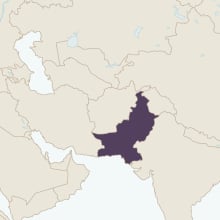
Public expectations were high as the Musharraf era came to an end in 2008 and Asif Ali Zardari and the Pakistan Peoples Party (PPP) came to power through democratic elections. The transition to more responsive government, however, has been challenging given political frictions and extremist violence as sectarian and ethnic tensions continue to destabilize the country.
Political Situation
The Pakistani government faces serious challenges including economic instability, political disorder, and insurgency in the Federally Administered Tribal Areas (FATA) and Khyber-Pakhtoonkwa. The security situation remains critical as an increasing number of attacks and bombings occur throughout the country, with targeted killings in Karachi at their highest rate of incidence since 1995. In January 2011, Punjabi Governor Salmaan Taseer was assassinated by his police guard Mumtaz Qadri. Qadri condemned Governor Taseer for his opposition to Pakistan’s blasphemy law, which dictates that criticism of the prophet Muhammad is a capital crime. Many consider Qadri a hero for defending Islam, underscoring the deep tension that exists between religion and politics in Pakistani society.
Though the U.S. continues to pressure the Pakistani army to root out the Taliban along the Afghanistan-Pakistan border, the army is reluctant to launch an offensive. Anti-American sentiment persists, stemming from U.S. drone attacks in FATA and recent U.S. support for India’s bid for a non-permanent seat on the United Nations Security Council. India and Pakistan have resumed bilateral talks, though tension over the 2008 Mumbai attacks remains.
In April 2010, Pakistan’s parliament passed the 18th amendment, a positive sign of democratic progress in the country. The amendment includes sweeping changes to the political system in Pakistan. It removes the president’s power to unilaterally dismiss parliament and gives the parliament, prime minister, judiciary and provincial governments greater autonomy. Political turmoil persists, however, as political parties vie for political power within parliament. The Pakistani government instituted an unpopular increase in fuel prices to bring Pakistan’s economic policies in line with International Monetary Fund (IMF) reforms, causing the Muttahida Qaumi Movement (MQM) to quit the ruling coalition in parliament. MQM’s departure left Prime Minister Yousaf Raza Gilani 12 members short of the requisite number to maintain leadership in the National Assembly. In response to political pressure, Prime Minister Gilani deferred fuel reforms, drawing criticism from international governments and the IMF. The MQM rejoined the ruling coalition, but the coalition’s grip on power remains tenuous.
NDI Programs
NDI is working with groups seeking to improve democratic institutions and civil society. In March 2002, the Institute opened an office in Islamabad and launched a program to assess the state of political parties in Pakistan. The Institute researched challenges facing the country’s political parties and identified reform-minded party leaders committed to strengthening democratic processes and institutions. Subsequent programs have focused on improving the ability of citizens to monitor government activity, providing training for journalists, increasing the skills of political party members, helping political parties to engage in local governance, and working with parties to promote sustainable dialogue on issues undermining Pakistan’s stability.
- Making our Institutions Work for Us: Strengthening Political Parties at the Local Level»
- Workshops for journalists on legislative reporting»
NDI and its local partner, the Centre for Civic Education (CCE), launched a program in March 2004 to enhance political parties' ability to undertake internal party reform. This pilot project based in the North West Frontier Province, now Khyber-Pakhtoonkhwa, was designed to support the emergence of reform-minded party leaders from parties committed to a democratic political system and was expanded into a multi-year United States Agency for International Development (USAID)-funded nationwide political party program. In June 2004, NDI implemented a U.S. Department of State, Bureau of Democracy, Human Rights and Labor (DRL)-funded program to promote women as political candidates and elected representatives.
In April 2006, NDI initiated a second DRL-funded program to strengthen youth participation in political parties.
The Institute has also been actively involved in supporting the electoral process in Pakistan. NDI organized international delegations to observe the national and provincial elections in 1988, 1990, and 1993.
-
Pakistan elections: foundation for democracy»
- Arrival statement of the international observer delegation to Pakistan, 1990»
- Preliminary statement of the international observer delegation to Pakistan, 1990»
-
Report on the 1990 elections in Pakistan»
- NDI observer delegation to monitor 1993 national and provincial elections»
- Preliminary statement, NDI international observation mission, Oct. 8, 1993»
- The 1993 elections in Pakistan»
In 1997, the Institute sponsored a pre-election delegation to assess election preparations.
In advance of the 2002 general elections, NDI organized nationwide trainings for over 1,200 party poll watchers. The Institute also produced and distributed over 550,000 party poll watching manuals, which were widely used on election day.
- Election day manual for polling agents»
- Political parties want consultation on appointment of new CEC»
In May and October 2007, NDI organized pre-election assessment missions in advance of parliamentary and provincial elections.
- Former Senate Majority Leader Daschle to lead NDI Pakistan election mission»
- NDI urges improvements in Pakistan's electoral security»
- Statement of the NDI pre-election delegation»
- Daschle sees little action thus far to ensure free and fair elections in Pakistan»
The Institute implemented a program that trained approximately 45,000 party polling agents to monitor polling stations on election day. NDI also worked with political parties to provide advice on the design and implementation of a communication system for the collection and analysis of election results and complaints.
Later in 2007, NDI completed a series of workshops in FATA which focused on the extension of the Political Parties Act to the tribal areas, reform of the Frontier Crimes Regulation, and the legal and constitutional status of FATA within the Pakistani federation. At the completion of the workshops, NDI’s partner organization, the Shaheed Bhutto Foundation compiled the recommendations from the workshops and published a report titled “Mainstreaming FATA.”
- Report: Mainstreaming FATA»
- New report details urgent need for democratic rule in Pakistan's tribal areas to stem unrest»
With funding from the government of the Netherlands, NDI conducted an assessment of the political parties in Pakistan that served as a baseline for the current three-year political party strengthening program. The program is modernizing party secretariats and increasing youth and women’s political participation. NDI is using an intensive consultative approach, with experts who meet with party working groups and key decision makers on a frequent basis. NDI is working in consultation with the parties to conduct research, develop reform strategies, and implement those plans.
In addition, the Institute is working with members of women and youth wings to develop and implement advocacy strategies that seek to increase their inclusion in party decision making and policy development.
- Women in Pakistan identify vital issues for party platforms»
- PML-N leader calls for women's quota for general seats»
- National action plan to boost women's power in Pakistani political parties»
- Extremism limits women's political participation and weakens democracy»
- Women from different political parties join forces to strengthen women's political participation»
In 2009, with support from the British High Commission, NDI facilitated a series of roundtables with political parties on policies for political reform in FATA. The purpose of the roundtables was to encourage and support parties to articulate policies on FATA reform. During these activities, political parties were able to deliberate on issues of concern to FATA with a broad range of individuals in an effort to reach a consensus on mainstreaming FATA. NDI incorporated input from tribal representatives into the policy development process.
- Political parties stress democratic reforms key for resolving FATA problems»
- Political parties urge FATA reforms essential for peace and stability»
- Parties call for immediate extension of political parties act and other reforms in FATA»
On Independence Day, President Asif Ali Zardari announced political, judicial, and administrative reforms for FATA which took into account the recommendations from the political party roundtables. NDI then held an additional roundtable at which senior leaders of the political parties agreed that the reforms would be necessary in mainstreaming FATA as part of the long term solution for stability in the region. In 2010 and 2011 the British High Commission supported NDI’s efforts to conduct a second series of roundtables focused on political party advocacy strategies for moving the FATA reform process forward.
- Nine political parties join to move FATA reforms forward»
- Pakistan to extend political reforms to FATA»
In addition, NDI received funding from the Canadian Government to support parliamentarians and party leaders to develop more effective party caucuses.
Contact Information
For more information about these programs, use our contact form or contact:
Islamabad
Sandra Houston, Senior Resident Director
shouston@ndi.org
Washington, D.C.
Raissa Tatad-Hazell, Senior Program Manager
(202) 728-5653


Subscribe to updates about Pakistan