The 2008 parliamentary elections resulted in the ruling Cambodian People’s Party (CPP) securing 90 of the 123 seats in the National Assembly. This victory affirmed the party’s control for another five years, supported the continued rule of Prime Minister Hun Sen, and allowed the party enough seats to govern without a coalition. Opposition parties, including the Sam Rainsy Party and the Human Rights Party, questioned the electoral results and raised formal charges against the CPP on widespread electoral misconduct, including voter impersonation, harassment and vote buying. Given this electoral outcome, Cambodian and international political observers expressed concerns about the continued domination of a single party in parliament, and the limited checks on future legislative activity.
While the ruling CPP has increasingly steered the country toward less political pluralism, with new laws passed to curb dissent among the opposition and in the media, NDI continues its collaboration with political parties and civil society dedicated to democracy and transparency. Over the past year, NDI has worked with local partners to host constituency dialogues (CDs).
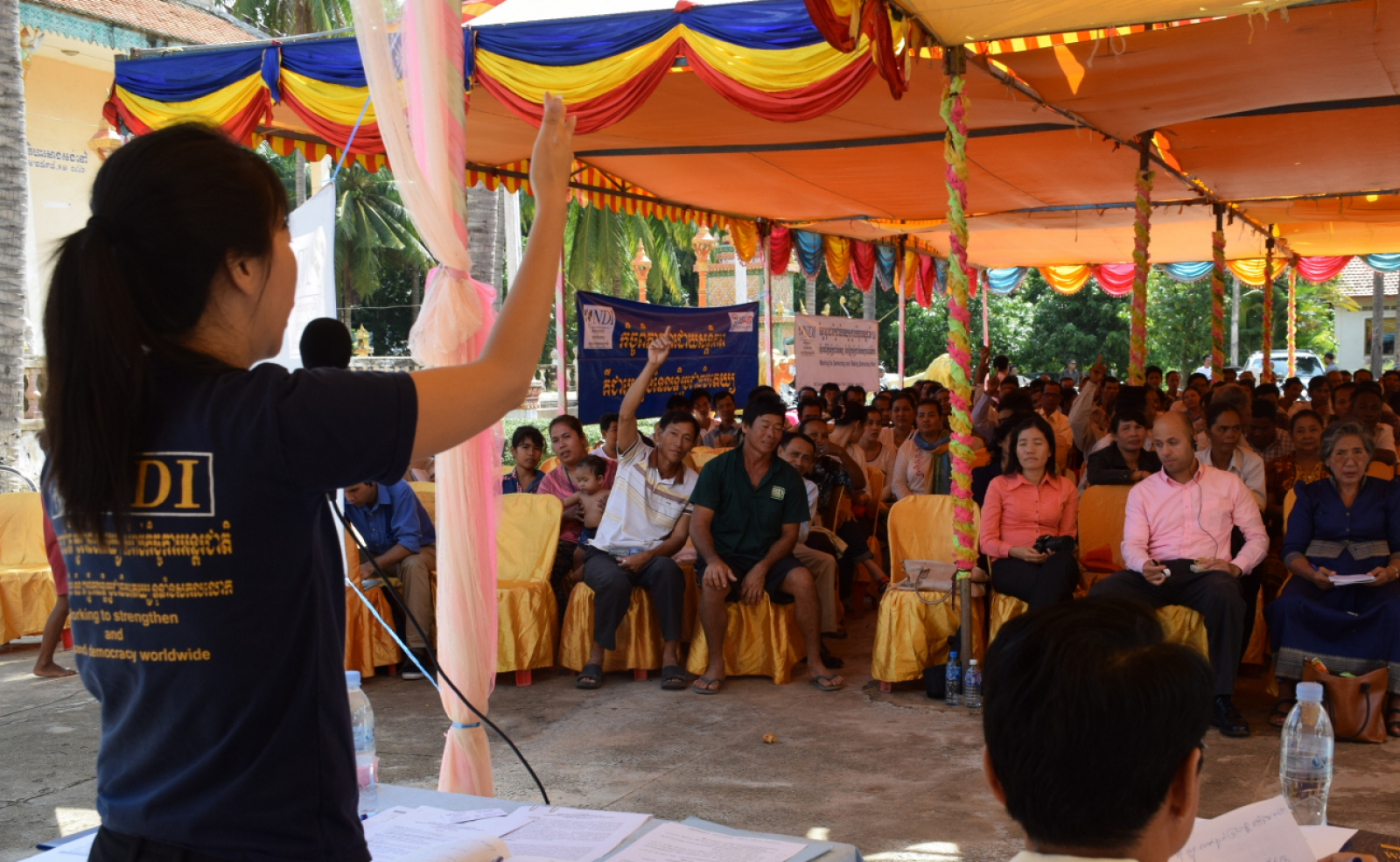
Under the constituency dialogue program, NDI, local NGO partners, and non-partisan community volunteers from each district organize and facilitate dialogues at the grassroots level to discuss community problems with their elected Members of the National Assembly (MNAs). During the dialogues, citizens raise community issues of concern and MNAs respond providing their solutions and ideas. Based on requests from both the MNAs and local partners, commune councilors or other provincial or local authorities will be invited to each dialogue and given the opportunity to respond to specific issues that fall under their jurisdiction, with the approval of the moderator and the participating MNAs.
Current Activities
Constituency Dialogues
To provide an avenue for broader interaction and more meaningful engagement between citizens and their elected representatives, NDI has organized multiparty constituency dialogues since 2004 involving representatives from all political parties that have seats in the National Assembly (NA). From January to July 2009, CDs were held in 10 provinces, all of which have multi-party representation: Banteay Meanchey, Battambang, Kampong Cham, Kampong Speu, Kampong Thom, Kampot, Kandal, Prey Veng, Siem Reap and Takeo.
For citizens, these constituency dialogues are a means to voice their concerns as well as to understand the roles and responsibilities of the National Assembly and elected officials. Parliamentarians use the dialogues to better appreciate the issues facing their constituents and to obtain information about specific problems. These dialogues are broadcast over local radio. In September 2009, NDI created and widely disseminated a progress report on the CDs to governmental and civil society organizations.
Over the next two years, NDI plans to hold 24 more CDs throughout the country. A pilot impact evaluation has been initiated to monitor their efficacy and evaluate the further success of the program.
Focus Groups
NDI uses focus groups to help measure the impact of the CD program on people’s attitudes, beliefs, or anticipated behavior. The same questions (with a few exceptions) are asked to the same group of people both before and after the CD in an attempt to capture any changes. Participants respond to questions on the role of officials and representatives, the main problems in their community, where they go for solutions to their concerns, and actions taken to address problems.
Promoting Electoral Reform
NDI collaborated with a technical working group, composed of Cambodian civil society leaders, to identify reform recommendations from evaluation reports and assistance programs around previous elections, including the July 2008 polls. In August, an electoral reform workshop was conducted to present these recommendations and build consensus amongst civil society actors and government officials on the implementation of these reforms. Two detailed reports have emerged from these activities. NDI created a report on the findings of its extensive year-long consultations and another on the results of the workshop. Both reports were distributed to relevant government agencies, international aid organizations and Cambodian civil society participants.
NGO Capacity Building
NDI has worked with partner NGOs in 10 provinces to strengthen civil society organizations through capacity-building training. The training focuses on dispute resolution, negotiation, advocacy skills, organizational management, organizational sustainability, networking, proposal writing, fundraising, and communication skills. Many of these partner NGOs are also undertaking programs to promote citizens' participation.