image of a compass
NDI

The National Democratic Institute is a nonprofit, nonpartisan organization working to support and strengthen democratic institutions worldwide through citizen participation, openness and accountability in government.

Mali

ml_2009Feb_Voter.jpg

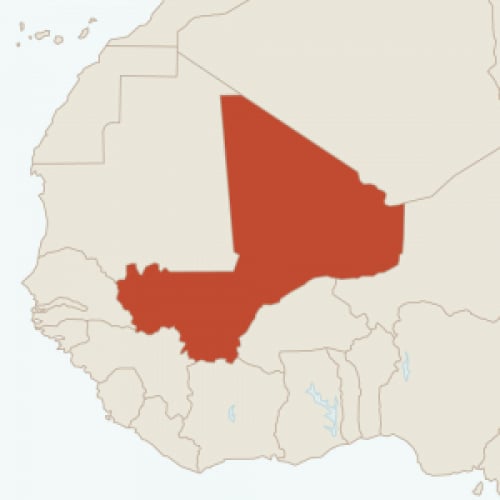
For the past two decades, Mali has been considered a model of democratic progress in West Africa.  This hard-earned accolade was compromised on March 22, 2012, when President Amadou Toumani Touré was deposed by mutinous soldiers just five weeks before the expiration of his term of office, derailing Mali’s plans to hold a presidential election and a constitutional referendum on April 29, followed by legislative elections in July.  Citing the government’s failure to prevent rebel groups from seizing control of Mali’s northern regions, the leader of the rebel soldiers, Captain Amadou Sanogo, announced that the National Committee for the Recovery of Democracy and the Restoration of the State (Comité National de Redressement pour la Démocratie et la Restauration de l‘Etat – CNRDRE) had taken control of the government. 

Within weeks, the CNRDRE bowed to substantial regional and international pressure and signed on to an agreement brokered by the Economic Community of West African States (ECOWAS) authorizing the creation of a transitional government.  Sanogo agreed to step down, and President Touré officially tendered his resignation on April 8, paving the way for the Constitutional Court to confer interim authority to Dioncounda Traoré, President of the Malian National Assembly, in keeping with Article 36 of the Malian constitution. The constitution requires that the interim president organize elections within 40 days of appointment.  However, given the threatening security situation in the north, the ECOWAS agreement acknowledged that the organization of elections in such a short time-frame was unlikely. On April 26, ECOWAS issued a communiqué in which it established a transition period of twelve months, within which presidential elections will be organized by Interim President Traoré and his newly appointed government. The junta has rejected the provisions of this communiqué, however, and has given other indications of its unwillingness to return government to civilian control.

Mali’s political turmoil has only emboldened a rapidly advancing rebellion spearheaded by the separatist group National Movement for the Liberation of Azawad (Mouvement National pour la Liberation de l’Azawad – MNLA).  Since Jan. 17, when the MNLA launched the first of a series of attacks against the Malian army in pursuit of autonomy for the country’s northern regions of Timbuktu, Kidal and Gao, the MNLA and other insurgent groups have continued to gain ground and begun to contest territory in the north.  In the past months, an estimated 300,000 people have been displaced within Mali or taken refuge in neighboring Mauritania, Algeria, Niger and Burkina Faso.  On April 6, the MNLA declared the independence of the Azawad, a territory encompassing the entirety of the three northern regions of Mali, and called for a cease fire.  However, other groups, among them some with Islamic affiliations that aim to impose sharia law in Mali, continue to seek to extend the territory under their control.

Current Activities

Supporting Transparent and Credible Elections in 2012

In July 2011, NDI launched a U.S. Agency for International Development (USAID)-funded program to help local civil society organizations to monitor key aspects of the 2012 electoral process, including the revision of the voters list and the holding of presidential and legislative polls.  At the program’s outset,  NDI and its partners, the International Foundation for Electoral Systems (IFES) and Internews, conducted a thorough assessment of the pre-election environment through  interviews with a wide range of stakeholders, including political parties, government, electoral management bodies, civil society organizations and local women’s and youth associations.

Since August 2011, NDI has been providing technical and financial assistance to enable its civil society partner Support to Mali’s Electoral Process (Appui au Processus Electoral au Mali – APEM) to monitor the public review period of the 2012 voter rolls, and prepare to observe election day proceedings for the presidential and legislative polls.  Between Oct. 1 and Dec. 31, APEM deployed 50 regional supervisors to observe the voters list revision at the communal level in each of Mali’s eight regions and the capital of Bamako. In its final pre-election observation statement issued on Jan. 31, APEM reported that, despite some irregularities, the process proceeded smoothly and in compliance with Mali’s electoral law.  

NDI has also assisted APEM to revise its election observation strategy so as to be able to analyze and report its observation findings in a more timely, systematic, and reliable manner.  From Feb. 6-7, NDI supported APEM to host a two-day colloquium on best practices in systematic election monitoring, and on integrating new technologies into such efforts. Immediately following the colloquium, from Feb. 8 - 10, APEM hosted a three-day meeting of the West African Election Observation Network (WAEON), which brings together domestic monitoring groups from 11 West African countries. Through its participation in the WAEON event, APEM was able to incorporate regional best practices and lessons learned into its 2012 monitoring effort, and to refine its observation strategy and tools.  On Feb. 13-14, NDI organized a training-of-trainers workshop for 51 APEM master trainers to prepare them to implement the updated observation plan, and enable them to conduct step-down trainings for 1,000 domestic observers in the upcoming months. 

NDI launched the political party strengthening component of the program in January. Under this component, NDI works with Malian political parties to monitor the electoral process and to mobilize broad, peaceful participation in the 2012 elections.  Through a four-step process completed during the months of February and March, NDI assisted parties to review the 2007 code of conduct and incorporate lessons learned from the application of this code into the 2012 version of the document.  In a March 20 ceremony that was widely covered by local media outlets, 43 parties and two independent candidates signed the document and spoke about the importance of all actors’ adherence to its contents.  Fifty-five parties, including each of the 13 parties with current parliamentary representation, participated in at least one lead-up activity that contributed to the signing of the code of conduct.  As a result of NDI’s facilitation of regular inter-party dialogue sessions, 22 parties produced a list of 12 joint recommendations for Malian election management bodies (EMBs) to pursue in order to secure credible, participatory and inclusive elections in 2012. 

NDI’s USAID-funded program is currently on hold as the U.S. government reviews its assistance programs in Mali.

Supporting Women’s Political Participation

Malian women face significant barriers to full political participation.  Women MPs currently represent a mere 10 percent of the National Assembly. In December 2011 the legislature voted unanimously in favor of a revised Family Code that failed to advance rights for women, deeply disappointing women’s rights activists both domestically and abroad.

Building on the success of past programs aimed at promoting women’s participation in the 2009 local elections that witnessed a 20 percent increase in the number of elected women councilors, NDI is implementing a 30-month program funded by the Royal Danish Embassy to promote Malian women’s participation in public life and politics. Through the program, launched in December 2009, NDI supports elected women at both the local and national levels, as well as women candidates who ran for office in 2009 but were not elected. The geographic focus of the program is based on an initial baseline assessment that identified the 113 communes (localities) located in eight cercles (administrative territorial units), in which NDI is focusing its support on elected women councilors.

In December 2010, NDI facilitated a self-assessment exercise through which leaders of 30 political parties reviewed and analyzed their party’s successes and shortcomings in attracting and supporting women party members and candidates.  Following the exercise, NDI organized a workshop to enable party representatives to share and discuss what they learned from their assessment. In January 2011, NDI facilitated a strategic planning workshop for both male and female legislators on promoting gender diversity in decision-making, and conducted a two-day orientation and training session on local development strategies and gender budgeting in the Koulikoro region. NDI established a partnership with Mali’s Union of Free Radios and Televisions (URTEL) and collaborated with the Centre Afrika Obota-Mali (CAO-Mali) to develop two skits portraying women leaders’ perspectives on the environmental implications of mining in Mali as well as their opinions on the successes and challenges of economic growth in the country. These broadcasts were the first in a series of television and radio programs designed to highlight women’s leadership on issues of national importance. NDI also completed a reference manual for women councilors.

From February-June 2011, NDI held public forums in three regions of Mali, in which women participants presented policy challenges of both national and local importance.  The forums enabled participants to better position themselves to effectively participate in local development planning and policy-making, and to build their constituent outreach and public speaking skills.  NDI leveraged its partnership with URTEL to broadcast these events through 20 local radio stations, reaching an estimated 1.7 million listeners through more than 150 messages.  The Institute also held a series of trainings for women councilors on gender-responsive budgeting and local development planning, as well as round-table discussions with women who ran unsuccessfully for office in 2007 and 2009. 

During the months of October – December 2011, the Institute organized a series of seven round table discussions with local women councilors, their constituents, and civil society organizations in eight localities around the country to discuss priority issues, including public health and education service delivery, women’s access to economic opportunities and barriers to women’s political participation. 

Once Mali establishes a revised electoral calendar, NDI will plan its activities according to the new electoral cycle to support the participation of women in the legislative elections as candidates, campaign staff and voters in the program’s three target regions.  NDI activities will include conducting candidate training and capacity-building activities; as well as continuing the ongoing media campaign to raise the profile of women as leaders and candidates.

Past Programs

Since 1996, NDI has worked in Mali to provide technical assistance for legislative oversight, electoral reform, voter education and domestic election observation, while promoting inter-party dialogue and women's political participation.

In December 2002, NDI launched a legislative program to support the Malian National Assembly’s active participation in the fight against corruption by enhancing the institution’s ability to exercise effective oversight of the use of public funds. Activities included a conference on the role of the National Assembly in fighting corruption, a roundtable for Supreme Court Councilors and legislators, and a seminar on legislative oversight for the finance and public works committees. NDI also organized a national anti-corruption forum to identify specific areas of collaboration between the National Assembly, the Supreme Court’s accounting and finance section, and civil society organizations.

The Institute distributed pollwatching materials and trained more than 1,000 party poll watchers ahead of the 2002 and the 2007 general elections. Following the 2007 general elections, NDI organized a series of roundtable discussions to help Malian political leaders reflect on the election process and develop recommendations to improve future elections.

To increase women’s participation in the political process, NDI trained more than 1,000 women candidates and widely distributed a training manual for women candidates in preparation for the 2004 local elections. Prior to the July 2007 legislative elections, NDI provided technical assistance to the Coalition des Associations et ONG Feminines du Mali (CAFO) and Groupe Pivot Droits et Citoyenneté des Femmes (GP), a network of Malian women’s organizations, to help them organize and subsequently evaluate a nationwide voter education campaign. NDI also assisted CAFO and GP to organize an orientation session to provide newly elected women legislators with tools to advocate for a greater role in the new legislature. Ahead of the 2009 local elections, NDI provided technical assistance to GP to train 3,000 women councilor candidates and conduct voter outreach in four of Mali’s eight regions. During this period, NDI and its partners, GP and the working group of women in political parties, organized an advocacy program to encourage political parties to support women candidates and an expansive get out the vote campaign through a network of community radio stations. These program initiatives contributed to an approximately 27 percent increase in the number of women candidates and a subsequent 20 percent increase in the number of women councilors elected.

NDI conducted a program to help parliamentary caucuses and political parties develop and clearly articulate policy positions. The program also assisted parliamentary committees contribute to policy reform with citizen input. In March 2010, the Committee on Education conducted a week-long study mission to examine education institutions in two of Mali’s regions. In preparation for the mission, NDI assisted the committee leadership to create data collection forms to document the committee’s findings. Following the mission, the president of the committee said that the mission marked the first time since Mali’s independence that a National Assembly committee had conducted such an activity. Through the program, NDI also co-organized retreats for parliamentary caucuses and party leadership where participants discussed communication strategies, formulated legislative agendas and prepared for parliamentary debate. The retreats have helped foster increased collaboration between party and caucus members on priority issues.

In December 2010, Mali concluded a program to help legislators oversee the country’s extractive industries sector. Funded by the National Endowment for Democracy (NED), the program sought to improve Malian legislators’ ability to participate in debates about mining reform and to engage in Mali’s ongoing efforts to receive validation from the Extractive Industries Transparency Initiative (EITI).  Specifically, the program focused its activities on the National Assembly’s mining and finance committees, helping committee members gather information about mining operations in Mali and creating links between the committees, relevant civil society representatives and other experts.  NDI also convened Malian legislators to exchange perspectives on legislative committee oversight of extractive industries and provided a forum for representatives from the Ministry of Mines to brief members of the National Assembly on proposed revisions to the mining code. Additional workshops held as part of this program covered the status of Mali’s EITI validation process, financial and tax issues associated with the mining industry, and finalized a directory of local and international experts on the extractive industries. Through this program, NDI has convened a variety of parties who do not normally have the opportunity to interact, including legislators and government officials, representatives from Malian civic groups, the World Bank, Mali’s Union of Mining Operators and major mining companies.

From December 2010 – March 2012, NDI implemented a program aimed at developing the National Assembly’s (Assemblé Nationale – AN) capacity to fight corruption, communicate with the general public, conduct and use legislative research, and increase women’s participation.  NDI’s program was part of a broader, five-year program supported by the Royal Danish Embassy, the United Nations Development Program (UNDP), and the Belgian Development entitled “Joint Program to Support Capacity Building of the Malian National Assembly" (Programme Conjoint de Renforcement des Capacités de l’Assemblée Nationale du Mali - RECAN).  To improve the assembly’s ability to communicate with the Malian public, NDI partnered with a local information technology firm to reactivate, update and develop a strategy for the ongoing maintenance of the National Assembly’s website.  During the April-August 2011 legislative session, the Institute organized a series of targeted capacity-building activities, including workshops on gender-sensitive legislative analysis and budgeting, and the use of the national budget as an anti-corruption tool. 

Funding

NDI’s current programs are funded by USAID and the Embassy of Denmark. Previous programs have been funded by USAID, UNDP, NED, UNDP, the Embassy of Denmark and the Embassy of Canada.

Contact Information

For more information about these programs, use our contact form or contact:

Bamako, Mali
Badié Hima, Resident Director
bhima@ndi.org

Washington, D.C.
Lauren Kunis, Senior Program Officer
lkunis@ndi.org

  Subscribe to updates about Mali