Success Story
Shifting the Landscape: Increasing Women’s Political Representation in Zambia
In Zambia, women remain significantly underrepresented in elected office despite the country’s longstanding democratic tradition. With general elections approaching, and with support from the Embassy of Sweden, an innovative program by the National Democratic Institute (NDI) is generating encouraging evidence that engaging influential male leaders alongside women political aspirants can help create a more supportive environment for women seeking public office.
While Zambia has long been hailed as a stable democracy, women’s participation in politics remains low. The number of women elected to public office at all levels of government decreased in 2021 from the 2016 election. As of the 2021 elections, only 16.8 percent of members of parliament were women, one of the lowest rates in the region, and only 7.1 percent of local council positions were held by women. Zambian women face significant socio-cultural and financial barriers to both running for office and to exercising full and meaningful participation in political parties.
To address these significant challenges, particularly at the sociocultural level, NDI is implementing an innovative program using a randomized control trial (RCT) to rigorously test the impact of multiple program interventions, including training for women aspiring candidates and social and behavioral norms change activities for local male leaders using the Institute’s flagship Men, Power and Politics curriculum. Under the “Enhancing Women’s Political Leadership and Creating an Enabling Environment for Representative Political Participation in Zambia” program, NDI has utilized interventions aimed at enhancing women’s political participation at the district council level, improving women’s access to local party and community leadership, and measuring the interventions’ impact on women’s sense of political efficacy, their willingness to run for office, and the impact of support from male gatekeepers in enhancing an enabling environment for women in politics.
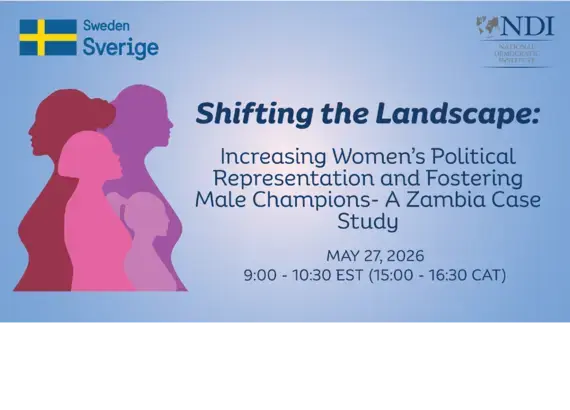
NDI recently hosted a webinar to delve further into the programmatic approach and its early results, highlighting promising findings on changing both the narrative around women’s political leadership in Zambia as well as on the rate of women’s political participation. With Deputy Head of Mission/Head of Development Cooperation at the Embassy of Sweden in Lusaka Christina Wedekull opening the conversation, NDI Zambia’s Ella Kamuyuwa and local partner Peter Chewe Mumba of Kasama Christian Community Care discussed the program’s design and implementation. Dr. Michael Wahman of the University of Texas, who has led the research team conducting the RCT in partnership with NDI, shared insights into preliminary results, including:
- Increasing women’s knowledge of and confidence in running for political office and serving on local councils.
- Increasing women’s active party membership.
- Women aspirants receiving informal party endorsements for their candidacy.
- Increasing the number of influential male leaders known by and connected to participants and the number of interactions with such leaders both during and following NDI’s programming.
- Male gatekeepers vowed to mentor and support women candidates, highlighting this as a strategy to expand women’s political participation and dismantle cultural and behavioral barriers that impede their involvement.
- The percent of male gatekeepers who agreed that men make better political leaders than women dropped from 30% at baseline to 18% at midline and 8% at endline.
- The percent of male gatekeepers who agreed that voters do not vote for women dropped from 39% at baseline to 16% at midline to 13% at endline.
While the research is ongoing, the “Enhancing Women’s Political Leadership and Creating an Enabling Environment for Representative Political Participation in Zambia” program demonstrates promising early results around the effectiveness of engaging male gatekeepers as allies in dismantling sociocultural barriers and creating a more enabling environment for women political aspirants. As Zambia prepares for its general elections, the program is contributing valuable evidence about approaches that could help foster women’s political participation and strengthen representative democracy.

More Success Stories
View All