
Success Story
Beyond the Numbers: Making Public Debt a Public Issue
Government loans are meant to support their ability to deliver essential services like healthcare, education and infrastructure for its citizens. Yet across Africa, rising borrowing and opaque loans terms have pushed many countries into unsustainable levels of public debt, putting these services under pressure. Today, 34 African countries spend more on debt servicing than on healthcare and education combined, leaving fewer resources for hospitals, schools and economic development.
When debt decisions are made without transparency or robust oversight, citizens pay the price. Limited public information about the size and terms of loans, combined with weak oversight by parliaments prevents citizens from understanding the financial decisions being made in their name and from holding leaders accountable. The consequences fall hardest on women, young people and vulnerable communities.
In Kenya, the National Democratic Institute (NDI) is working with civil society partners to make information about public debt more accessible to citizens and engaging with elected leaders to advocate for policy changes. Recognizing that fiscal policy discussions can be difficult to understand and engage with, NDI partnered with a spoken word poet to translate abstract fiscal concepts into art that resonates with citizens’ lived experiences. The performance frames parliament as the country’s “heartbeat of accountability,” questioning gaps in oversight while connecting national borrowing trends to everyday realities, including delayed public services and rising living costs.
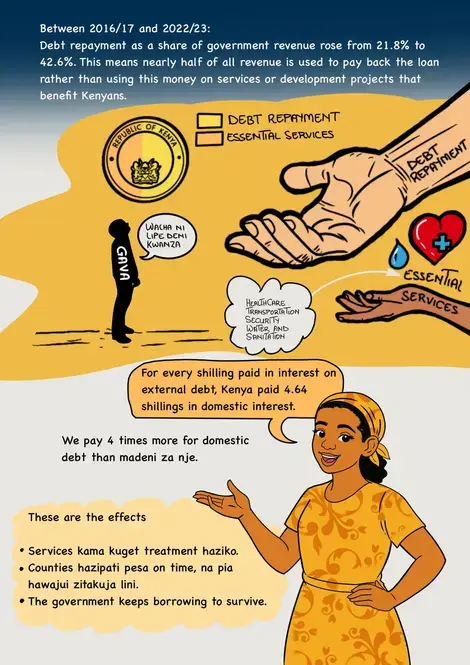
Illustrated infographic breaking down Kenya’s domestic debt and its impact on citizens.
“Every budget line carries a human face … every loan we take is a story — a road promised, a hospital delayed, a mother taxed twice, first in hope… then in heartbreak.”
The poem demonstrates how creative expression can be a powerful tool for civic education. This work builds on NDI’s broader efforts in Kenya to make research on public debt more accessible to citizens, including a Political Economy Analysis on public debt and a set of illustrations that break down statistics and research using visual storytelling tools. This initiative in Kenya reflects NDI’s wider regional efforts to strengthen debt transparency and accountability in public finance.
- In Malawi, NDI supported civil society advocates in elevating public debt into a national campaign issue, showing how citizens can use elections to influence borrowing decisions by raising awareness and building public pressure, including ensuring that these issues featured in pre-election presidential debates.
- The Institute also worked directly with Malawian parliamentarians, providing training and tools to review debt more critically and strengthen legislative oversight, so that debt decisions are examined before approval.
- In Zambia, NDI supported a coalition of civil society organizations to improve debt management laws and advocate for greater transparency in government borrowing.
Across these contexts, NDI’s approach is consistent: expand access to debt information, strengthen institutional checks and balances, and equip citizens to engage meaningfully on economic decisions that shape their futures.
Transparency in public borrowing is not only a fiscal concern — it is a democratic imperative. Citizens have a right to receive information about financial decisions made in their name, and understand how public money, whether raised through taxes or borrowed through loans, is spent. When complex finance concepts are translated into accessible language, people are better positioned to demand accountability, protect public resources and shape the economic decisions that will define their countries’ futures.

More Success Stories
View All