Success Story
Bringing Elections into the Modern Age: Digital Electoral Integrity in the Western Balkans
In the Western Balkans, electoral processes have grown more complex in the digital age. As new tools or technologies, such as artificial intelligence, evolve, they bring a dual-edged reality: the power to both threaten and revolutionize electoral integrity. This dynamic cuts across all areas of elections: political campaigns have largely migrated to social media, foreign actors weaponize manipulated information, campaign finance transparency faces regulatory challenges, legislative remedies stagnate, and observer groups are continually challenged to adapt and expand to assess new integrity areas. In short, the survival of free and fair elections is at stake.
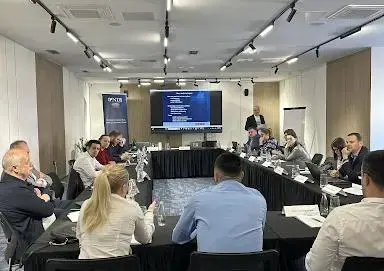
To address these challenges, the National Democratic Institute (NDI) organized a dynamic regional conference on digital electoral integrity from April 22 to 24, 2026 in Becici, Montenegro, under its regional NED-funded Europe Regional: Advancing Democratic Integrity, European Integration, and Youth Engagement in the Western Balkans program. The Institute convened 19 leaders and practitioners from Albania, Bosnia and Herzegovina, Moldova, Montenegro, Poland, Romania, and Serbia. The event centered on regional exchange to identify shared challenges and potential solutions in the ever-changing digital election space, helping to safeguard free and fair elections built on accountability and efficiency.
“I especially appreciated the openness of the discussion and the diversity of participants [NDI] brought together. [...] I hope we can use this platform to send a strong message not only that observers are indispensable, but most importantly that we need to work together with EMBs, parties, media and the international community - this is not a one person job!”
- Election Expert from Poland
To enrich conversations, provide multi-disciplinary perspectives, and break out of traditional silos, NDI curated a diverse group of participants, including legal and elections experts, as well as representatives from civil society, parties, Central Election Commissions, regulatory agencies, and the media. Participants reflected on the value of such a diverse range of geographic and professional backgrounds present, noting that it helped them uncover shared vulnerabilities and identify collaborative opportunities to strengthen the electoral environment, both across sectors within their own countries and the broader region.
Over two intensive days, participants tackled best practices, emerging challenges, and new tools through keynote speeches, open discussions, and case studies on recent Polish, Romanian, Moldovan, and Hungarian elections. Sessions dove deep into critical issues, such as identifying and addressing foreign and domestic information manipulation and interference, promoting campaign finance transparency, and adapting to online election observation. Participants also engaged in interactive discussions, sharing regional experiences on these topics throughout the Western Balkans, examining the real-world consequences when democratic guardrails erode, and identifying practical tools to defend the integrity of elections.
This cross-regional dialogue allowed participants representing the Western Balkans and Moldova, Poland, Romania, and Hungary to learn from one another and develop stronger solutions tailored to the Western Balkan context. For example, a pivotal moment of the exchange occurred when discussing Voting Advice Applications (VAAs), a tool that helps “match” citizens to the party most closely aligned with their beliefs based on a questionnaire. While successful in Western Europe, participants from the Western Balkans highlighted a critical local reality: that party platforms often drift from policy action. This led to a breakthrough recommendation: rather than just tracking campaign promises, these tools must be anchored in actual legislative records. It was a masterclass in hyper-local adaptation to ensure global technology works for the specific needs of the Western Balkan citizen.
“I [...] found the workshop both engaging and highly constructive. Throughout the workshop, I came to realize that the entire region is, to a certain extent, facing similar challenges [...]. This highlights the importance of dialogue and cooperation among all stakeholders involved, and reassures us that we are not an isolated or hopeless case, but rather that there is a real and tangible opportunity to bring about positive change.”
- Political Party Finance Expert from Albania
When discussing the utility of Voting Advice Applications (VAAs) in Western European democracies, a tool that helps “match” citizens to the party most closely aligned with their beliefs based on a questionnaire, participants from the Western Balkans raised concerns. Specifically, a participant noted that such a tool may not be applicable as party platforms often do not result in actual policy changes. This frank exchange underscored the need to adapt tools and programming to local contexts and led to the recommendation to embed tools like VAAs within broader election information campaigns, as well as to integrate a party’s actual legislative track record into the matchmaking process, rather than relying solely on campaign promises.
By the end of the conference, participants walked away with a set of 12 concrete recommendations detailing how to better engage youth, inform the public during elections, combat manipulated information online, enforce campaign finance regulations, and identify and address coordinated information manipulation networks. Due to NDI’s convening power, nearly 50 percent of participants were political party representatives, helping to ensure that these recommendations can actually be translated into tangible legislative change following the conference. Participants from parties and other backgrounds alike expressed eagerness to bring these strategies back to their countries to advocate for next steps in promoting more free and fair elections across the Western Balkans.

More Success Stories
View All 
Europe and Eurasia