Success Story
Amid Multiple Threats, Moldovans Stand for Freedom and a Democratic Future
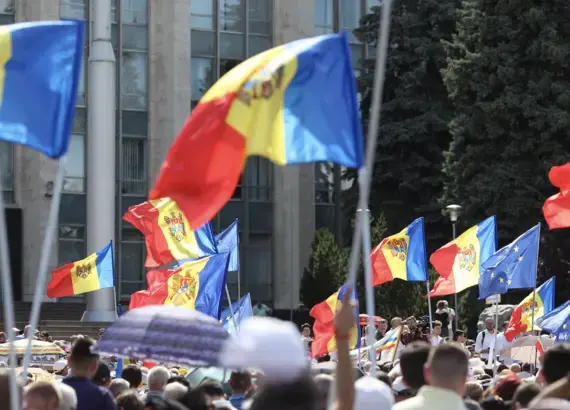
Ahead of Moldova’s September 28 parliamentary elections, citizens knew what was at stake. According to NDI’s pre-election public opinion research, 70 percent of respondents believed this would be the ‘most decisive’ vote in the country’s recent history — a choice between continuing reforms and progress towards joining the European Union or returning to rule by pro-Kremlin parties.
Despite a torrent of authoritarian propaganda on social media, massive illicit financing attempts, and cyberattacks on digital electoral processes, Moldovans turned out in large numbers and gave a majority to the pro-EU Party of Action and Solidarity (PAS). As Paula Cardoso, Special Coordinator and leader of the Organization for Security and Cooperation in Europe (OSCE) short-term observers noted, “Moldovans demonstrated a high level of commitment to democracy amid unprecedented hybrid threats coming from Russia.”
NDI’s assistance to Moldovan partners in 2025 built on experience from the 2024 presidential election and constitutional referendum. In those polls, a high-level NDI election observer mission helped to shed light on a sophisticated scheme to bribe 130,000 Moldovan voters, a number large enough to sway the result in this small country.
Learning from that episode, Moldovan institutions and civil society moved quickly to avoid a repeat. Working alongside those local efforts, NDI supported a major persuasion and awareness campaign about the impact of vote-buying. This nationwide information campaign, launched well before the electoral campaign period, encouraged Moldovans not to sell their votes. Television networks and online outlets carried these messages, which reached millions across the country. These efforts complemented new, stronger anti-corruption laws and increased police efforts to investigate illicit financial flows, demonstrating a whole-of-society commitment to clean elections. On October 6, the head of Moldova’s General Inspectorate of Police noted that voter corruption in this year’s election decreased relative to 2024, citing ‘prevention’ efforts.
To ensure that Moldovan leaders craft effective messages, research supported by NDI included surveys, focus groups and message testing. The findings showed that many Moldovans empathized with fellow citizens facing poverty and pressure to sell their votes. Based on those insights, media outlets and civic leaders shaped positive, forward-looking messages on voter empowerment and shared responsibility, rather than focusing on punishment or blame. Further research helped partners tailor their outreach to different audiences — by age, gender, and language — ensuring that every Moldovan heard messages that spoke to their values and experiences.
The research findings were shared with key Moldovan government institutions, including the President’s office, the Central Election Commission (CEC) and the National Anti-Corruption Action Center, as well as major political parties. The messaging advice was subsequently reflected in high-level government statements and informed the CEC’s efforts to refine its own voter communication strategy, particularly in emphasizing trust in the electoral process during the final weeks of the campaign.
At the grassroots level, two civic groups — Pune Umarul (“Lend a Hand”) and De Facto, a youth organization — conducted voter education, both to enable voters to make an informed choice and to promote confidence in the integrity of the electoral process. Through 46 groups of activists across the country, Pune Umarul, met with hundreds of rural voters, while De Facto reached thousands online. Both groups began by asking voters what mattered most to them, and then designed videos and articles linking these issues to the importance of casting an informed vote. Support from NDI helped strengthen these locally led efforts, which contributed to a substantial increase in voter turnout compared to the last parliamentary elections, particularly among young people.
In the coming weeks, NDI will conduct additional public opinion research to better understand how Moldovans perceived both anti-bribery messaging and the authoritarian propaganda that filled the information space. Moldova has and continues to serve as a testing ground for hybrid interference, and the lessons drawn from this election will inform NDI’s support to partners across Europe and Eurasia who face similar challenges.
For more than two decades, NDI has stood alongside Moldovan citizens, civil society and institutions in their pursuit of accountable and transparent governance, supporting for genuine, citizen-centered policymaking and the professionalization of civil service. These long-term partnerships have helped lay enduring foundations for a democracy that listens and delivers for its people.
The 2025 elections reaffirmed that even amid hybrid threats and attempts to buy influence, the democratic aspirations of the citizens remain stronger than any effort to undermine them. As Moldova continues its path toward deeper democratic consolidation, NDI remains a committed parter–helping the country build on its progress and sharing its lessons with others confronting similar challenges. This small but pivotal country continues to punch above its weight in the global effort to defend freedom and democratic values.

More Success Stories
View All 
Europe and Eurasia