Success Story
Political Parties as the Missing Link: Reconnecting Citizens and Democratic Governance
Across Southeastern Europe, trust in political parties remains among the lowest of any democratic institution. Yet parties remain the primary mechanism through which citizens influence government. As public frustration grows, political leaders, civic watchdogs and policy experts from across the region will gather this summer to explore a critical question: how can parties reconnect citizens to democratic governance?
Political parties serve as the vital bridge to translate citizens’ interests, concerns, and aspirations into representation, policy, and governance. Parties play a central role in electoral processes, stimulating political participation and structuring competition during elections. Beyond the ballot box, they shape how policies are developed and how legislation is advanced, translating societal demands into actionable political agendas. By organizing political competition and anchoring it within party structures, they also provide a crucial safeguard against the personalization of power, ensuring that political authority is exercised through institutions rather than individuals alone.
The National Democratic Institute’s (NDI) work with political parties across Europe and Eurasia focuses on reviving this connection. At the core of this approach is a nonpartisan model that engages actors across the political spectrum and creates inclusive spaces for dialogue and learning to strengthen democratic practices. Under its regional National Endowment for Democracy (NED)-funded “Advancing Democratic Integrity, European Integration, and Youth Engagement in the Western Balkans” program, NDI will convene political party representatives from across Europe and Eurasia to tackle three key challenges that weaken the link between citizens and politics.
First, NDI will work to make EU integration more meaningful to citizens in Becici, Montenegro. From June 5 to 7, NDI will transform the way parties approach and communicate about European Union (EU) integration. Rather than treating integration as a distant, bureaucratic checklist, this event will reposition EU integration as a fundamentally political process and empower political parties to be active agents of reform. In collaboration with its NED-funded Southeast Europe Regional: Promoting Democratic Governance in the Western Balkans, NDI will include parliamentary monitoring organizations (PMOs) – civic watchdogs that help citizens navigate and influence politics. NDI will combine strategic reflection with practical tools to help parties translate complex EU reforms into issues that matter to everyday people, while better equipping PMOs to provide relevant, accessible, and timely information to citizens and build broader political and societal coalitions for reform. By bridging the gap between these civic watchdogs and political parties, this activity will forge stronger coalitions for reform and create space for comparative learning between actors operating in different stages of the EU integration process.
Next, NDI will tackle the urgent challenge of restoring public trust in democracy through effective, fair and ethical governance. In Pristina, Kosovo, from June 26 to 28, NDI will bring together senior political leaders, governance experts and practitioners to examine how parties can better align their leadership with ethical standards, institutional accountability and citizen-centered policymaking. Participants will explore practical approaches to ensuring that parties - even after winning power and entering government – continue to invest in internal structures, strategic direction, and oversight mechanisms that sustain both performance and integrity.
The Institute will explore how parties can strengthen their ability to develop responsive, representative, public policies that respond to citizen needs in Sofia, Bulgaria from July 3 to 5. Against the backdrop of declining trust, polarization, and growing citizen dissatisfaction, the activity is designed to move beyond theoretical discussions and examine how policy is actually formed in practice. Participants will consider hard questions: where do gaps emerge between citizen needs and party agendas, and why does policymaking often remain reactive or disconnected from real-world priorities?
Across these areas, one principle remains clear: democracy delivers best when political parties deliver. Strengthening the efficiency and fairness of democratic institutions, therefore, requires elevating parties both as electoral actors and as representative, accountable and policy-driven organizations. When parties reconnect with citizens, invest in substantive policy, and take true ownership of governance, they can begin to rebuild trust by delivering the results that matter most.
NDI will share more about the impact of these events after implementation.

More Success Stories
View All 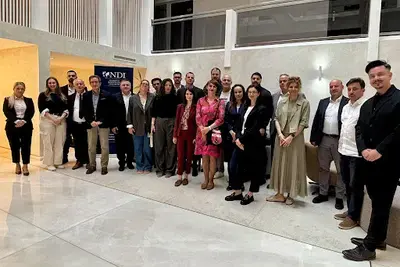
Europe and Eurasia