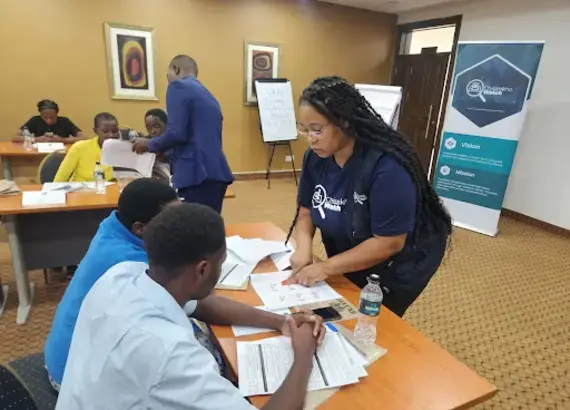
Photo: Chisankho Watch Voter Registration Observer Training
Success Story
Election Observation as a Democratic Safeguard in Malawi
Malawi’s upcoming elections present a pivotal opportunity to strengthen public trust in democratic institutions and reinforce the country’s commitment to fairness and accountability. At the forefront of this effort is Chisankho Watch, a non-partisan and citizen-led election observation initiative spearheaded by a coalition of four Malawi civil society organizations and supported by the National Democratic Institute (NDI).
The objective of this partnership is as simple as it sounds: to watch over the election process. Launched in 2024, Chisankho Watch—”chisankho” meaning “election” in Malawi’s native Chichewa—is mobilizing a nationwide network of nearly 900 nonpartisan observers to monitor all stages of the electoral process: voter registration, party nominations, campaigning, and election day procedures. Drawing on NDI’s global experience in supporting credible elections and the deep local knowledge and trust that the coalition members’ bring to the table, Chisankho Watch is working to enhance electoral transparency, encourage civic participation, and build confidence in the outcome of the September 16, 2025 elections

Photo: Chisankho Watch Press Conference on Voter Registration Observation
The coalition is employing innovative data collection tools, and by using the process and results verification transparency (PRVT) methodology, Chisankho Watch will be able to confidently assess whether all parties and candidates are treated fairly in the lead up to election day, whether all eligible voters are afforded equal opportunity to participate in the election, if manipulation occurs during voting or vote counting, and, ultimately, whether the official election results are accurate and the process was fair and honest. In addition to this, the PRVT will allow Chisankho Watch to assess the quality of the election day process and predict where the credible results of the election should fall. As demonstrated through research from other African nations, such observation efforts deter fraud and provide independent and credible information, allowing voters to have greater trust in their elections.
As Tuntufye Simwimba, Chisankho Watch’s Project Coordinator, explains “Our role is not to call out the Malawi Electoral Commission, but to support it to hold a fair and a transparent election thereby enhancing the credibility and integrity of the entire electoral process, starting from pre-election, election and post-election period.”
This work is especially important given the broader context in which the upcoming elections will take place. Following weeks of protests, Malawi's Constitutional Court overturned the 2019 presidential election due to irregularities, triggering a rerun in 2020 under a new requirement order by the Court that candidates must receive more than 50 percent of the total vote to win the election without a runoff. Lazarus Chakwera (Malawi Congress Party/MCP) won the 2020 presidential election with 59 percent of the votes, besting incumbent President Peter Mutharika (Democratic Progressive Party/DPP), who received 40 percent.
The requirement was widely viewed as a step toward greater political representation and national unity, intended to encourage inclusive campaigning and reduce the long-standing regional and ethnic divides that have shaped Malawian politics since the country's inaugural democratic elections in 1994. Despite that progress, the road ahead is anything but certain.
The September 16, 2025 elections will be conducted against the backdrop of rising economic hardship, waning trust in public institutions, and the death of the popular and charismatic Vice President Saulos Chilima (who was expected to contest for the presidency) in a plane crash in June 2024. Interest in participating in elections is also on decline. While nearly 10 million Malawians were eligible to register for the 2025 elections, only 7 million did so, and public confidence in democracy has dropped from 76% in 2012 to just 53% in 2025, according to a recent Afrobarometer survey released in June 2025. Furthermore, opposition political parties have raised concerns about the Malawi Electoral Commission’s (MEC) openness about new technology tools that will be used for the polls and the MEC’s denial of civic groups’ request to conduct an independent review of the voter register.
Yet even amid these challenges, Malawians are not retreating from democracy; they are actively working to protect and improve it. The work of Chisankho Watch, supported by NDI, underscores how citizen engagement and international partnerships can strengthen electoral integrity and bolster democratic resilience. The forthcoming elections are not just about choosing leaders; they are a test of Malawi’s democratic commitment and a chance to advance the values that citizens care about most: peace, security, stability, and prosperity for all.

More Success Stories
View All